Explode the BOM against a work order, earmark stock with a reserve, and issue it to the line — the moment material really leaves store stock. Then book good, reject and scrap at each operation. Stock commits only where it should: at issue and at finished-goods transfer.
Material flow here isn't a spreadsheet bolted onto production — it rides the same stock ledger as the warehouse. Everything starts from a released BOM exploded against a work order, and every step is a real document with a real state.
A production requisition explodes the released BOM against the work order, so the shortage list is the real bill for the quantity you're making, not a guess. Reserving that material posts RES/WO: the stock is earmarked against the order so it can't be double-committed to another job — but on-hand quantity is untouched. Nothing has physically left the store yet.
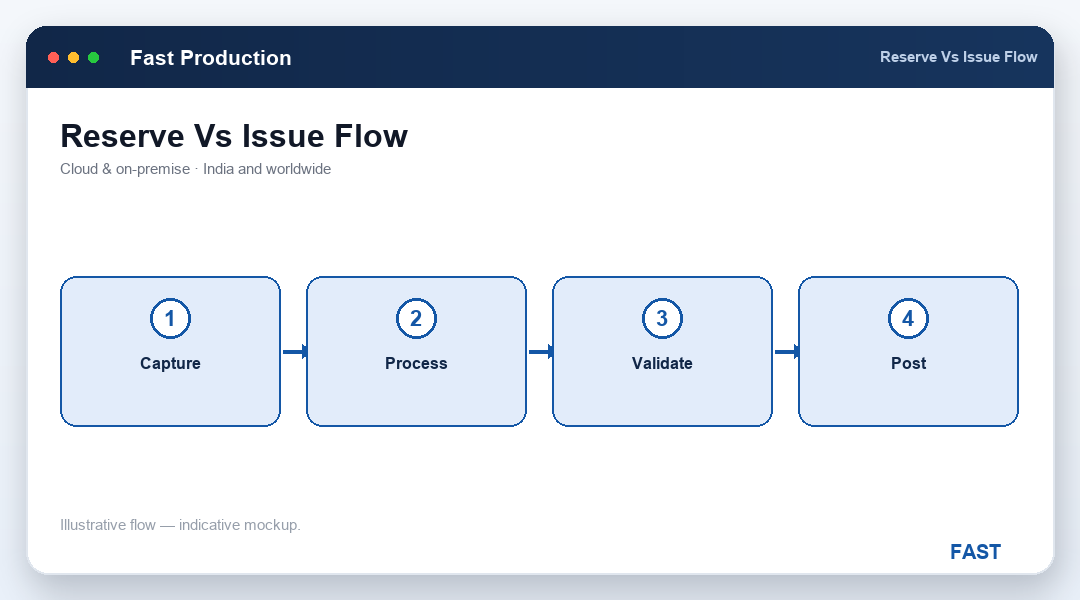
Issue is the real deduction. When material goes to the line, the issue slip posts ISS/IWO: the quantity leaves store stock and is charged to the work order, so your on-hand ledger and the job's consumed cost both update at the same instant. Got the wrong item or quantity? Reverse the issue. Line left material over? Return it to stock on the same slip. Cancel a reserve or issue and it posts as CRES or CISS — nothing is edited away silently.
As parts move through the route, operators book output at each operation: good quantity as WIP/OKPLUS, reject as WIP/OKNOTOKMINUS, and material lost as process scrap (PSCR). This is where in-process yield becomes visible — you can see how much of a work order is at each stage and how much fell out as reject, per operation and per work center, long before final inspection.
Production slips move the accepted WIP quantity from one operation to the next, and finally into finished goods. This is the principle that keeps the numbers honest: stock only truly commits at two points — material leaves at issue (ISS/IWO), and finished goods land in stock at transfer (FGP/FG). WIP bookings track quantity through the route without touching finished-goods stock until that transfer, so on-hand FG never overstates what has actually been made.
Explodes the released BOM against the work order into a real material line list — the shortage bill for exactly the quantity you're making.
Earmarks stock so it can't be double-committed to another job. No stock movement — the on-hand ledger is unchanged until you issue.
The real deduction — material leaves store stock and is charged to the work order. The one point where raw-material stock truly moves.
Reverse a wrong issue, return unused material on the same slip, and cancel a reserve or issue as CRES / CISS — every correction is a document.
Book WIP/OKPLUS, WIP/OKNOTOKMINUS and PSCR at each operation, so in-process yield and reject rates are visible before final inspection.
Move accepted WIP operation to operation and finally into finished goods — the route's quantity flow, kept off FG stock until transfer.
Most inventory drift on the shop floor isn't theft — it's material committed twice, issued off the books, or WIP counted as finished goods too early. New to the category? Start with what is production management software?
Reserve (RES/WO) earmarks stock against a work order so it can't be double-committed to another job — but no stock moves yet and on-hand quantity is unchanged. Issue (ISS/IWO) is the real deduction: material leaves store stock and is charged to the work order. Stock only truly commits at issue, so your on-hand ledger stays accurate until material physically goes to the line. Reservations can flow straight from Fast Planning / MRP.
At two commit points only: material leaves store stock at issue (ISS/IWO), and finished goods land back in stock at FG transfer (FGP/FG). A reserve is just an earmark, and WIP good/reject bookings track quantity through the operations without touching finished-goods stock until the route is complete and transferred.
At each operation on the route, operators book good WIP (WIP/OKPLUS), reject WIP (WIP/OKNOTOKMINUS) and process scrap (PSCR). Production slips then move the accepted WIP quantity from one operation to the next and finally into finished goods, so you always know how much of a work order is at each stage and how much fell out as reject or scrap. This connects directly to the process & route sheet for each work center.
Yes. A wrong issue can be reversed, unused material can be returned to stock on the same issue/return slip, and a cancelled reserve or issue posts as CRES or CISS. Every reserve, issue, return and reversal is a document in the shared stock engine, so the ledger and the audit trail stay consistent.
Yes. Every reserve, issue and FG transfer posts to the same stock engine the warehouse uses, so raw-material depletion and finished-goods receipt are immediately visible to inventory and dispatch. Reservations flow from Fast Planning / MRP, and rejects branch into Fast Inventory & Quality — one continuous chain, no re-keying.
A live walkthrough of requisition, reserve, issue and good/reject WIP capture on a work order like yours — with the AI reject analysis on top. No generic slideshow.