A part can pass every operation and still not exist in inventory. Fast Production makes the moment exact: FG and SFG transfer to on-hand stock, lot-tracked finished goods, part and child-part line rejection booked against the work order, and a rework loop that salvages to FG, returns to the main flow, or scraps — nothing quietly written off.
Making the part is the middle of the job. The last mile — landing good stock, catching what failed, and salvaging what can be saved — is what turns a completed work order into honest finished-goods stock and a defensible reject-and-rework trail.
Finished goods land as on-hand stock only at the FG transfer — the FGM manufacture event and the FGP/FG posting that deposit them into the same stock ledger your warehouse and dispatch read. Finished goods can be lot-tracked so every unit carries its batch, semi-finished goods transfer up the assembly tree to feed the next-level build, and over-production goes through excess FG transfer so nothing is booked twice. It's the clean handoff from the line to inventory and quality.
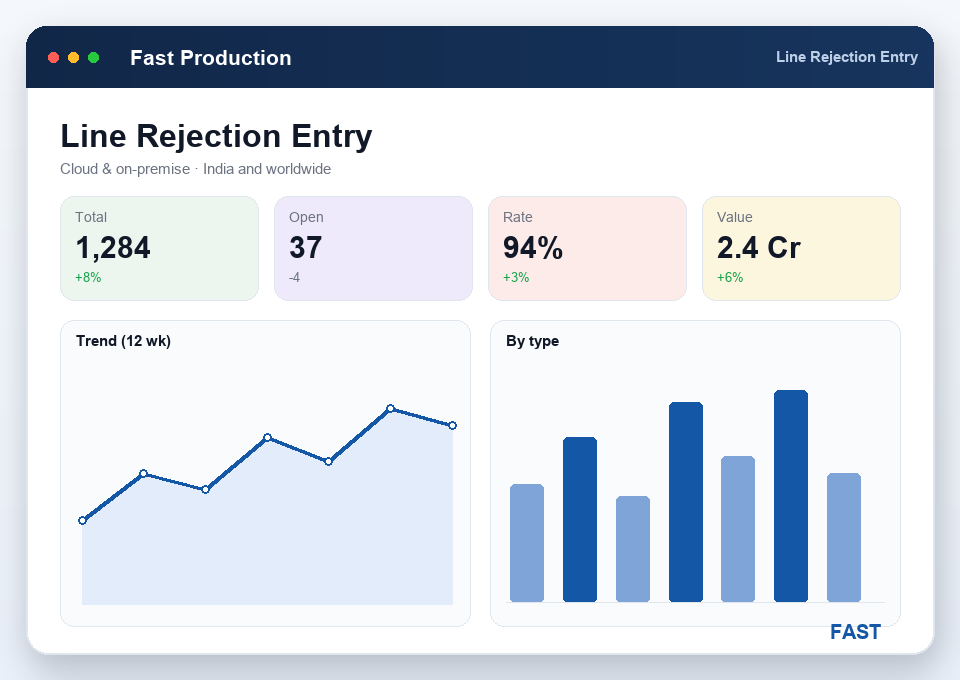
Line rejection is parts that fail on the production line — distinct from incoming-material rejection at goods receipt. Fast Production captures it at the level it happened: the manufactured part, or the specific child part or component inside it, always booked against the work order that made it. From there the rejected quantity can raise a purchase requisition for replacement material against the BOM, or drop straight into the rework loop — with reject alerts pushed to the line lead on WhatsApp. It ties back to the operation and work center on the route sheet.
Rework isn't a note in a spreadsheet — it's its own routed sub-process. Define a rework route for the rejected quantity, then execute and track each rework operation with good/reject capture just like the main line. Because it runs on the same process engine as production, a reworked part carries the same operation history as a first-pass one, and the rework report keeps quantity and status in one place. It reuses the discipline of WIP good/reject capture you already run on the floor.
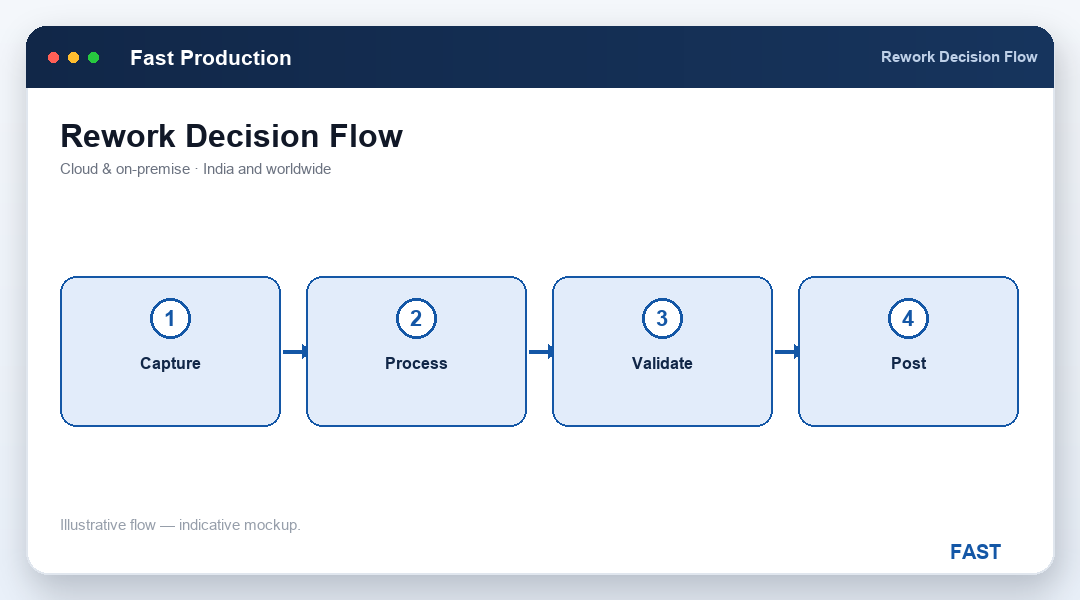
Every reworked part resolves one of three ways, each recorded. Salvage transfers the recovered part into finished goods; a transfer-back returns it into the main work-order flow to continue as normal; and what can't be saved is booked as process scrap (PSCR), not quietly written off. The result is a rejection-and-rework trail you can put in front of an automotive component customer or a quality auditor — quantity in, quantity salvaged, quantity scrapped.
FGM manufacture and FGP/FG transfer deposit finished and semi-finished goods into the shared stock ledger, lot-tracked where you need it.
Over-production is transferred through a dedicated excess FG path so surplus finished goods are added to stock without double-booking the order.
Part-level and child-part-level rejects, booked against the work order — the record of what failed on the line and where.
Define a rework route for rejected quantity, then execute and track each rework operation good/reject on the same engine as the main line.
Reworked parts pass to FG or back to the main flow; unsalvageable quantity is booked as process scrap (PSCR) — every ending recorded.
FG receipts post to the same ledger as inventory and quality and reservation from planning/MRP, while Dhruv AI clusters reject reasons into themes.
"Done at the last machine" is how stock drifts and rejects vanish. For the wider picture, read our guide on reducing production rejection and rework.
Only at the FG transfer. A part can pass every operation and still not exist in inventory — it becomes on-hand stock at the FG manufacture event (FGM/FGM) and the FGP/FG posting that deposits it into the same stock ledger your warehouse and dispatch read. WIP good and reject bookings track quantity through the route without touching finished-goods stock until that transfer.
Line rejection is parts that fail on the production line while the work order is being made, booked against that work order. Incoming-material rejection happens earlier, at goods receipt, when purchased material fails inspection. Fast Production captures line rejection at the level it happened — the manufactured part or the specific child part inside it — and links it to the operation and work center on the route sheet.
Yes. Line rejection can be entered against the manufactured part as a whole or against a specific child part or component within it, and either way it is booked against the originating work order — so you know not just that a unit failed, but which component caused it. Reject reasons can then be clustered by Dhruv AI.
A rework route is defined for the rejected quantity and each rework operation is tracked good/reject. Every reworked part then resolves one of three ways: salvaged parts transfer into finished-goods stock, reworked parts are returned into the main work-order flow to continue as normal, and what can't be saved is booked as process scrap (PSCR). All three are on the rework report.
Yes. A rejected line quantity can raise a purchase requisition for replacement material against the BOM, tying the shortfall created by rejection straight to procurement so the work order can still be completed on time.
Live demo of FG/SFG transfer, part and child-part line rejection, and the full rework loop — on your own work orders. No generic slideshow.